
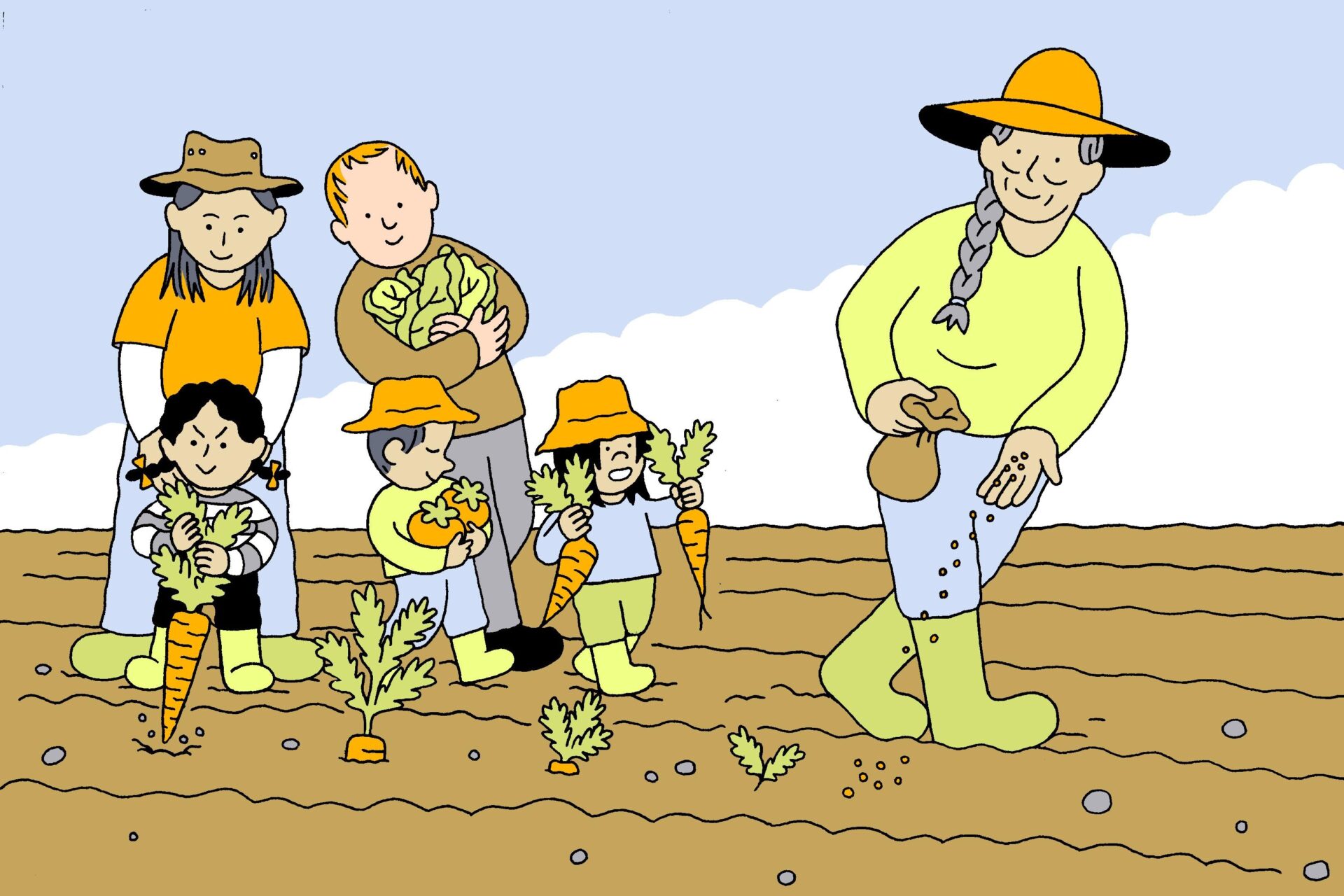
How can you reap what you sow while sharing with your descendants too? | Pete Gamlen for Vox
Hi readers! Shayla Love here, science journalist and longtime fan of Your Mileage May Vary. I’m honored to be subbing for Sigal Samuel while she’s out on parental leave. I’m diving into your questions as a way to help understand human nature and our choices through multiple lenses: philosophical, psychological, and beyond. Please send in any emotional, body/brain, sociological, perceptual, or other kind of life quandaries you might have.
I am a (gracefully?) aging mother of three and proud grandmother of four. I keep hearing about how my generation (okay, I am a boomer) is hoarding wealth and failing to pass it down.
When I look at my lifestyle, I’m facing a fork in the road. Either I splurge on a lovely retirement, or I save so my kids and their kids can have an easier life. We’re all middle-class, so this is not a question of survival. The kids have college funds. Do I owe it to my descendants to scrimp as I age? Surely it’s not right for me to spend my savings on bucket-list vacations…How should I balance spending on myself and on the others that will come after me?
Dear Rainy Day Funder,
I’m so glad to hear you’re not in financial survival mode. But you are facing some economic constraints: You can’t splurge on a luxurious retirement while at the same time saving a substantial nest egg for your kids and grandkids.
Have a question you want answered in the next Your Mileage May Vary column?
Fill out this anonymous form! Newsletter subscribers will get my column before anyone else does and their questions will be prioritized for future editions. Sign up here!
It sounds like this feeling of either-or is causing you some anguish. The instinctual response is, as you suggest, to hoard as much as possible for your progeny to use later on. But at the same time, that feels like it’s zero-summing your own experience in your golden years.
So I’d like to introduce you to an economic thinker who has some advice that might surprise you. John Maynard Keynes, 19th-century British economist, would say: Don’t save your money!
Keynes wrote that when times are tough, people react by keeping their money close, and not spending it. But this sets in motion what he called the paradox of thrift. One person’s expenses are actually another person’s income, he pointed out; if everyone saved their money, no one would make money either, and a recession could drag on and on. In the end, people’s savings would, paradoxically, go down, even though they were scrimping.
We can apply the paradox of thrift to your own family as a mini-economy. Inheritance has traditionally worked by setting aside large chunks of your assets to pass along to your children and grandchildren — which could be helpful when the day of windfall comes. But why wait? And would waiting actually stymie your family’s financial potential?
In past generations, an inheritance like this often happened far earlier. I’m comforted that we are living longer (an average of a decade or more longer) than in the mid-20th century, but this sets up new issues, as you’re stuck in, with when and in what quantity to transfer any extra resources.
Now, as people retire with decades of good life to enjoy ahead of them, they are often doing so at the very same time their adult children are the most financially stressed: They are trying to buy homes, they’re in the busiest middle part of their careers, and many have children of their own they’re raising and trying to save for.
This doesn’t mean you have to give away all your money to your family so that they can spend it on the pleasures you have given up. Keynes wasn’t anti-savings so that money could be spent frivolously. He did believe that spending money was one of the best ways to give the greater economy a boost. Perhaps there are ways you could think about spending your money that stimulate your family’s internal economy, that also help you enjoy your retirement.
For example, you could invest in a lakeside property to kick your feet up at — an asset that will appreciate in value over time and be sold at a profit, or be passed down through the generations to enjoy for many summers to come. Maybe you assist your children in buying a home — one with a comfortable guest suite. You could invest in a business your children want to start, and help them grow something that could accrue more wealth over time. Using your money these ways may even feel more like splurging than scrimping! Yet, it ideally would achieve both: a fun way to spend your hard-earned money now, and create more abundance for your family’s future.
A hidden bonus of non-traditional inheritance moves like these is that they all involve spending more time together with your family and potentially even strengthening those relationships along the way. The Greek philosopher Aristotle wrote in The Nicomachean Ethics that there were three kinds of friends. Some are based on utility, and exist only because of what people can get from one another. Other friendships are based on pleasure, when you like doing things with someone. Finally, friendships of virtue persist because you stick by people who inspire you by their strong character. Simply setting aside your money is a relationship that leans utilitarian. Working on a shared meaningful project could help deepen your relationships with your kids and grandkids in those pleasurable and virtuous directions.
Speaking of, I don’t think you need to be making these decisions alone.
You used an interesting word in your question: Do you, as an individual, owe it to your family to set them up with a more comfortable financial future, at the expense of personal indulgences? A lot of the discussion around older generations’ money, and whether or how they should pass it on, avoids dealing with this sticky moral component. Why should parents give their kids money?
I think there’s clarity to be found in thinking more closely about why we owe each other anything.
There are few better thinkers to turn to than Confucius to consider our obligations to family. The fifth-century Chinese philosopher believed that we can’t understand ourselves only as individuals. You are nobody when you are alone; you only come alive as a mother, a daughter, or a sister. These relational roles each come with specific duties and ways of interacting. Successfully fulfilling these roles within the family has a bigger impact, according to Confucius. It’s what creates the foundations for a harmonious and functional society. For children in this web of relations, it’s critical to uphold filial piety, or the need to respect, honor, and care for parents as well as all of their other elders and ancestors.
Filial piety has, over the years, been criticized for being too rigid, and setting overly high expectations for blind obedience and conformity in children. So I’ve been interested to see the concept of reciprocal filial piety emerge. In reciprocal filial piety, children have a genuine feeling of gratitude to their parents for raising them, and any obligation they feel is heartfelt — they want to return the favor and care for their parents too.
As a half-Chinese person, I find it interesting that in family life in the West, filial piety is often reversed. There’s a lot of air time discussing what parents owe their children, and not so much the other way around.
For example, I noticed that you don’t mention how your family intends to care for you in the future, or what they might feel a sense of owing you. If you do take a Keynesian approach to your family and decide to spend your money in ways that could benefit everyone, it might be worth engaging in some Confucian-tinted conversations not only about what you owe everyone else, but what you all appreciate about each other.
You can reflect, together, on how your family is stronger because of all the ways you’ve chosen to look after one another, not only because of how much money is in the bank.
Bonus: What I’m reading
I think it’s worth having a copy of The Analects of Confucius lying around, which is full of nuggets of wisdom. One morsel I recently read was about how to best get along with others: “The gentleman harmonizes without being an echo. The petty man echoes and does not harmonize.” The lesson is that we don’t gain much by blindly following and copying what other people do. The most harmonious way to be in a society, or even a family, is to have interlocking roles that complement each other, like different pitches do in a choir.
I thought a lot about getting older when reading this piece on death doulas by Alexandra Schwartz in The New Yorker. It serves as a reminder that people outside of the immediate family can also help with life’s hardest transitions.
And, for something fun: I enjoyed this investigation by Natalie Wolchover in Quanta on why she (or anyone) is left-handed. She explores left-handed stigma and neuroscience, as well as a theory about humans using their right hands because they once were better to win fights with.
